I dropped Amazon a line with links to let them know that both of these books are being offered free elsewhere and they very kindly dropped the price to free on Amazon as well. As I have mentioned before, I can not list a book for free on Amazon, but they can match the lowest available price -- if they choose to. This can change at any time.
Since giving my stories away -- or selling them at the lowest price I can -- is my way of "advertising", I'm very happy that Amazon has once more dropped the price to free. In the nearly 6 months The Bright Black Sea was for sale at $3.99 and then $.99 I may have sold less than 30 copies. Ten times that many were downloaded in the first 10 days after being reduced to free. The way I look at is that the price of getting read by hundreds of readers is the royalties of half a dozen books sold a month. In short, not much.
Books By C. LItka

Tuesday, September 13, 2016

Monday, August 22, 2016
A Note on Fauna

One of the Pela's
any sorts of feathered fauna, a “sentry serpent” first appeared in
The Black Bright Sea. In the first edition of this story, the sentry
serpent was incorrectly described as a snake rather than as a serpent
type of dragon. I regret this error. I can only claim that term
“sentry serpent” led me to assume the creature was a snake rather than the long, Chinese-style " serpent dragons" of the
Pela. That, and the great distance from which this story originates –
untold numbers of light years and perhaps 80,000 years in the future.
At the time I rather wondered how this creature could move – my
inaccurate description had it moving by a combination of wiggling and
expanding and contracting it's feathers never seemed to make much sense. And so on further investigation I discovered my mistake.
This mistake was
corrected in later editions of the story. (Non-Amazon editions can be
updated with new editions from Smashwords and iBooks. Newer editions,
in addition to this correction have many typos corrected as well.
Highly recommended.)

Siss
The actual
sentry-serpent, or Simla dragon as it is know in the part of the Pela
that the Castaways of the Lost Star takes place in, is a serpent
dragon which looks much like a rather slim, feathered crocodile. (See
the quick sketch above.) Simla dragons move in weightless conditions
much like earth crocodiles swim through water, using their tail, with
it's feathers extended to create a broad paddle, and with a little
help from their legs.
I mention this
because that a Simla dragon is a character in the Castaways of the
Lost Star, and if anyone reads that story from the first edition of
The Bright Black Star, may well be confused by the metamorphosis of
this sentry-serpent into something rather different.
Thursday, August 4, 2016
Castaways of the Lost Star

The adventures, and
misadventures of Captain Wil Litang continue with the release of The
Lost Star Tales #2, Castaways of the Lost Star. Wil Litang is
back to spin another of his “old spaceer's” tales, this time of
danger and romance amongst the floating islands of the Archipelago of
the Tenth Star. When we had last seen Litang, at the end of The
Bright Black Sea, he
had embarked on what proved to be an ill considered mission to warn
the friends he'd left behind that the old leader of the
counter-revolution, Hawker Vinden, could not be trusted. And that he
was brutally ruthless enough to murder a dozen people, including old
friends and shipmates, just to insure the secret of the Tenth Star
did not leak out.
As we know from the
end of The Bright Black Sea,
something went awry. Litang awakens in the wreckage of the gig
smashed into on a small floating island that is drifting ever deeper
into the archipelago. And he finds that he's not alone – a very
mixed blessing.
Castaways of the
Lost Star is the first story, or “episode” in Litang's
adventures amongst the islands of the Archipelago that will be
(hopefully) eventually collected into The Lost Star's Sea, a
companion volume to The Bright Black Sea. It is, however, a
novel length story – nearly 73K words long – and acts as the
hinge between Litang's adventures in the Nines Star Nebula and his
new adventures in the Archipelago of the Tenth Star, wrapping up the
loose ends in the former and introducing some of the mysteries and
settings in the latter.
Whereas the first
book of Litang's adventures was an old style space opera, written in
a richer, more character-driven style than the old pulp adventures,
Castaways of the Lost Star is a “planetary romance” redone
in a similar matter. It seems that the Edgar Rice Burroughs stories
that I read in my teen years, many years ago, left their mark in all
my writings, and in this story I've taken the typical Burroughs story
with a shipwrecked hero in a strange land filled with danger and
romance and re-imaged it my style, turning a few of the conventions
upside down, while still paying homage to those wonderful stories of
Barsoom, Venus, Pellucidar and the Land that Time Forgot.
Castaways of the
Lost Star is available for FREE on Smashwords, and will make its way to iBooks,
Barnes & Noble, and Kobo in the next few days. It is also available on Amazon
for $.99, Amazon's minimum price, along with The Bright Black Sea.
Smashwords offers a FREE kindle compatible version if you care to
take the trouble to side load the mobi version on to your kindle. I
am not in the “business” of writing or selling books. I write and
publish my stories simply because I enjoy the writing and sharing of
them, so that FREE is my preferred price.
Sunday, July 24, 2016
Are Indie-published Ebooks the New Pulps?
Indie eBooks or ePulps?

Indie-publishing may be a very different beast than most people give it credit for. Its readership and
reader expectations differ significantly from those of traditional
publishing. It might pay to view ebooks, and especially indie-publishing, not as the 21st century version of traditional book publishing, but as the 21st century version of the fiction magazine – the
“pulps” of the past. If this is the case, then ebooks may not be the future of book publishing, but rather, destined to remain a
semi-autonomous niche market. Far fetched? Let's look at the many parallels
between the pulps and indie-publishing so that you can decide for
yourself.
The pulp magazines
of the first half of the last century were "cheap reads," like the indie-published ebooks
today. In the pulp era, when hardcover books cost
between $2 to $3, with the cheaper reprints at a $1, most pulp
magazines sold for $.10 to $.20. Today, with hardcover books' cover
price in the $20 to $30 range, and traditionally published ebooks
running $12 to $16, most indie-published ebooks cost between $1 and
$5; priced just like the pulps when compared to traditionally published books, and aimed at same, budget conscious readers. The similarities, however, go much deeper than just price.
Like the pulps,
indie-published ebooks appeal to avid readers – readers who consume
stories faster than traditional publishers release them. Just as the
pulps met the demand for more stories, more often, indie-published
books, released by the thousands each week, supplement the
traditional publishers' slower release cycle.
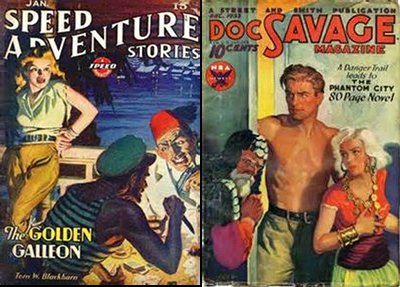
And like the pulps, indie-publishing, with it's low overhead and cheap, ebook
format, can profitably serve niche markets; markets too small, or too
controversial, for traditional publishers to bother with. In addition, many indie-authors, like pulp publishers, often make slim profits on each issue, but enough to keep cranking out titles year after year.
The similarities
extend beyond price, volume, and profits. It's reflected in
content as well. As I mentioned above, the pulps offered stories for
every reader, every interest and taste. There were pulp magazines
devoted to railroads, air planes, submarines, zeppelins, ships and
the sea, cowboys, detectives, gangsters, science fiction, fantasy,
horror, boxing, sports, and all types of romance stories.
Indie-published ebooks offer the same sweeping spectrum of stories for every taste, no matter how obscure.
The distribution
model of pulps and ebooks also share the distinction that, unlike
traditionally published books, you're not likely to find them in
bookstores. The pulps were sold on newsstands, in drug stores, and in
other non-traditional book venues. Today indie-ebooks, POD print
books, and audio books are mostly sold online, rarely finding their
way into bookstores.

Indie-ebooks and
pulps share more than just a similar market. Their subject
matter, writing styles, and writing philosophy are very similar as
well. Of course there is a wide variety of small press and
indie-published books, many of which don't follow the pulp formula,
yet it seems that many of the most successful ones do. Readers of
both the pulps, and indie-published ebooks, tend to be story
orientated readers rather than style orientated ones. The great
secret in publishing is that many readers are not all that fussy when
it comes to how stories are written. If the story draws them in, and
they find it entertaining, they'll turn a blind eye to how well it's
written. “Pot boilers” have always sold well.
Moreover, not only do readers value stories more than writing, they
like the familiar. Stories written in familiar formulas are welcomed,
rather than despised. Much of the advice given to aspiring
indie-writers promote the pulp, formula of writing. Give them stories
you know they like – research your market. Write fast, one draft if
you can. Write short, 50K word novels, short novellas, and short
stories. Publish frequently to keep readers engaged. Find a formula
that works and stick with it. And write series, where not only the
formula, but the characters are familiar. I'm not saying that this
style is universal in indie-writing, only that it makes up a good
portion of the commercially successful indie-ebooks exactly because
it appeals to the same type of reader that was attracted to the pulps
in their day.

Some pulp writers, like indie-writers, found great commercially success, despite the fact that neither the pulps or indies stories are reviewed in the mainstream media. In the hay day of
pulps, there were pulp writers making movie star incomes, just as
there are millionaire indie-writers today. And, like today's
indie-authors, many new writers wrote for the pulps before moving on (or “up”) to traditional publishing – just like the
many successful indie-writers do today. Conan Doyle, Edgar Rice
Burroughs, P G Wodehouse, Raymond Chandler, Ray Bradbury, and H P
Lovecraft, just to name a few started their careers writing for the
pulps. Like their modern counterparts, pulp writers sold their work in many formats from traditional books to Hollywood screen plays, like
today's hybrid writers and indie-writers who diversify
into POD books and audio books. The first
Tarzan movie came out only a few years after it appeared in the
pulps, like The Martian today. This entrepreneur spirit, is a feature of both the successful
pulp and indie author
.
There are, of
course, many differences as well. Pulp writers, for example, wrote
for a much smaller audience – pulp magazine editors. The magazines
offered an established brand and provided services like editing and
story guidance, ideas, proofreading, and marketing at no charge to
the writer. The magazines, being anthologies, helped new writers
reach readers and convey credibility by their association with both
the magazine and its more well known contributors. These days,
indie-authors must pay for many of these services out of pockets–
and bear the financial risks involved in publishing as well.

Despite the
differences, it seems to me that the indie-publisher today is the
direct descendant of pulp writers of the past. And that their markets
are functionally the same. If that is the case, then the
indie-published ebook market should be viewed as something distinct
and different from the tradition print book market – not only in
form, but in function as well.
So what?
Well, for the
indie-writer it may mean looking at their business a bit differently,
since it's a different tradition with, perhaps, a different future than traditional book publishing. Traditional book publishers might
want to take a hard look at their position in that market with a
historical perspective. They co-existed with, and survived long after
the pulp market died off. They may not be able to outlive the
indie-ebook market, but they can almost certainly co-exist with it.

The question then
arises, do they need to compete in the ebook market at all? They
left the pulps be pulps, so could they not turn a blind eye on ebook
publishing as well? Given that they make something like 1/3rd of their
incomes comes from ebooks, the answer might be a “No!” – if it
meant abandoning that income entirely. But does it? If a publisher
has a stable of proven, popular authors, wouldn't these authors draw
most of their readers back to the print, if that was their only
option (at least on first release)? How many ebook customers of
traditionally published ebooks are entirely committed to reading
ebooks and only ebooks? Is there not still time to draw a line
between “books” in paper, and indie-published ebooks or in
effect,“ePulps”?
Given that the
(discounted) price of the paper edition is not much more than the
agency ebook price, any resistance to this change would likely arise
only from the format rather than price. I would argue that as of
today, that risk seems modest. So, with the modest risk of leaving a
few customers behind, traditional book publishers would create the
opportunity of redefining both ebooks and print books. By exiting the
ebook market, at least for hardcover and trade paperbacks, they could
then draw a bold line in the sand. They could then make the case
(rightly or wrongly) that there is a clear distinction between
“real,” traditionally published authors, who write “real”
books that are carefully selected and edited for a quality reading
experience, vs the non-curated indie-published, “ePulps”, rejected stories written
by beginners and amateurs, and published in great numbers on the cheap.
And by removing their hardcover and trade paperback library from
their ebook offering, they would drive business back into the
business they know best – paper publishing.

Still, they need not
abandon the ebook market entirely. They could release the ebook
versions of their “real” books a month or two after the book's
mass market paperback release, priced competitively with indie
ebooks, say $5.99 or less. In this way they would eventually reach
every potential customer; from the eager hardcover buyer to the
budget reader willing to wait for the cheap ebook, without diluting
the idea that traditionally published books are fundamentally
different from indie-published “ePulps.”
While I'm playing
the devil's advocate here as far as what traditional publishers might
think and do in the ebook market, I feel comparing indie-publishing
to pulps is valid. A lot of people think the big five publishers are shooting
themselves in the foot with their high prices for ebooks, but they may just be too timid. Yes, the higher prices set them apart
from the indies, but by withdrawing their newest, most in-demand
books, they might make that distinction even sharper. In the past
there was a distinction between “pulp writers” and “paperback
writers” and published authors of "books." Fair or not, they could make that
distinction again, and reinforce it by keeping their authors out of
the indie-writers' ebook market, and perhaps secure a mindset for
their paper books for many decades to come.

There are many
people who say that ebooks are the books of the future, and if
traditional publishers don't embrace change, they are doomed for
irrelevance down the road. I'm old enough to know, that, even if they
are right, it's unlikely happen before we're all driving flying cars.
And when you consider that cassettes, eight-track, CDs, itunes, and
streaming music services haven't managed to push vinyl records into
the dumpster of history (They're Back!), I have to believe that paper
books have a long, long future ahead of them no matter what. Indeed,
since ebooks are dependent on digital technology, which changes very
rapidly, I'd say that one should wonder more about the staying power
of ebooks than that of paper books.
For information on
the pulps I consulted The Pulps, Fifty Years of American Pop
Culture, edited by Tony Goodstone, researched consultant: Sam
Moskowitz

Wednesday, July 6, 2016
Castaways of the Lost Star Arrives 4 August 2016

Coming 4 August 2016!
It is back to plan A -- releasing the first story in the story cycle that will hopefully make up The Lost Star's Sea as a stand alone novel. Writing went well over last fall and winter, and I'd gotten at least half, and more likely 2/3rd of the way through The Lost Star's Sea, and though that I might publish it in two volumes. However, on going over it again while doing the 2nd draft, I realized that I had ended that part in the middle of nowhere -- I would've taken you some 180K words into the world, and then leave you stranded, with no clear objective in sight.
Not publishing something, however, would mean no story for at least a year. I decided that wasn't wise either, so it's back to plan A.
The good thing is that I think that the first episode or story in the story cycle -- Castaways of the Lost Star -- works well as a novel. It has a beginning, middle, and an end -- though, of course, the end is far from final. Moreover, it serves as a hinge between The Bright Black Sea set in the Nine Star Nebula, and The Lost Star's Sea set in the Archipelago of the Tenth Star tying up some loose threads from the first while beginning the world-building of the Pela.
I've also decided to give the series the over all title of "The Lost Star Tales".
Here's the blurb for Castaways of the Lost Star:
Captain Wil Litang's adventures, and misadventures, continue
with Litang finding himself shipwrecked on a small drifting island after a
rather ill-advised return to the Archipelago of the Tenth Star to warn his
friend of treachery. Unless he can repair his space boat and contract his friends,
he faces the daunting task of surviving among the floating islands of a vast
ocean of air --islands populated by telepathic dragons, strange, and savage
beasts, dangerous, and mysterious peoples and civilizations. In the grand
tradition of “planetary romances” Litang must survive, and, if not quite
conquer, at least find his place, in the uncounted and unknown islands of
the fabled Tenth Star.
Just as The Bright Black Sea reworked the classic space
opera into a modern, character focused novel, Castaways of the Lost Star starts a new series that revisits and resets the classic planetary romances
from the pens of Edgar Rice Burroughs and Jack Vance, into a long, rich, and character
focused novel.
Castaways of the Lost Star is the novel length, 72K word, opening chapter of an extended story cycle that will form a fitting companion
volume to The Bright Black Sea.
As before, this story will be released for FREE on Smashwords and distributed to iBooks, Barnes & Noble, and Kobo, on Amazon it will be $.99. (In most cases Amazon requires a price of at least $.99. They might match the FREE price when I call their attention to the fact that they're being undersold.) I've also reduced the price of The Bright Black Sea to $.99 for a limited time.
Monday, July 4, 2016
New Cover Art for The Bright Black Sea

I've uploaded new cover art for The Bright Black Sea for the Amazon edition. This actually (if far from ideally) illustrates a scene from the story. As I've mentioned, I don't really have anything more than an impression of the scenes I write, so that I'm left with constructing one limited by my artistic talents. Luckily, gimp provides digital tools to greatly enhance my efforts. Trust me, the original of this is really bad.
I will be updating the cover of my other editions shortly.
I've also changed the name of the series to The Lost Star Tales, with The Bright Black Sea being volume #1, at least for now. I am somewhat torn in that the Volume #1 could be considered a collection of the first three tales and The Lost Star Tales #2 will be only one tale, so it should be more accurately numbered #4 since it will be only the first episode in the full story of Wil Litang's adventures and misadventures in the Archipelago of the Tenth Star. The complete work, The Lost Star's Sea will likely be as long as The Bright Black Sea. However, since I don't see that project being completed before mid to late 2017, The Lost Star Tales #2, Castaways of the Lost Star will be a stopgap measure, consisting of the opening tale or episode of the larger book. I'll be posting more details on that in the coming days.
Once I have the #2 in the series out, we'll see if Amazon will let me once more list The Bright Black Sea for FREE. I believe they allow authors to give away the first book in a series to prime the pump for the rest of the books. I'm going to have to look into that once I have Castaways of the Lost Star listed.
Saturday, June 25, 2016
It Has A Name
The name is
aphantasia.
In the blog post
where I talked about the failed covers of The Bright Black Sea, I
mentioned that I could not picture peoples' faces in my head, or
indeed, as I explored my mind more, that I could not picture anything
clearly in my head. At best I'd “see” a vague impression, from
which I might be able to piece by piece reconstruct an image. For
example, I can probably draw a good picture of my house without
looking at it, because I “know” what it looks like without
actually “seeing” it in my mind, at least not as a complete
image.
The reason why I
mentioned this in the post was because I had considered a cover with
characters on it, and rejected it for two reasons. The first was that
I had no clear mental images of my characters. In my writing, you'll
find few references to how they look, most are vague and you're free
to ignore them, which reflects the fact that I don't have pictures of
real people, people I see everyday and/or have known all my life,
much less make believe ones. I could, I suppose, make a spread sheet
of each character's physical characteristics, tall,/short,
blond/black/brown/red hair, etc. and then just plug those features in
when writing about that character, but since there appearance isn't
important to me, I'd probably never think about doing it anyways.
The upside is that
rather than try to compensate for this imaginative gap with a cheat
sheet, I just outsource the job to you, my readers. You're free to
imagine them anyway you like. Anyway they appear in your mind while
reading about them goes. And that being the case, I didn't want to
give them any physical appearance on a cover or interior art. They're
yours to image.
A few weeks after
that post, I came across an article that describes this condition of
not being able to see images in one's mind, a condition called
aphantasia.
The
BBC article is here: http://www.bbc.com/news/health-34039054
I
suppose there are degrees in every condition. I have no trouble
finding my car in a parking lot, and I don't think I would even if it
wasn't bright green. (My
wife's choice.) I
still can
find my way around
places I've visited in many years. And strangely enough, I'm pretty
certain
that I dream in fairly images, though that's a bit hard to say,
because while
I retain
the impression of images,
I
can't recall more
than an impression of those
images – the condition reasserts itself in my waking mind.
I
found
this
interesting. I had realized long
before this article that other people could recall
events much
more vividly in mind than I could, so
the
condition itself
was
no surprise, only
that it was a diagnosed condition. I
don't see it as any sort of handicap. I'm
a painter, after all, and most of my paintings are strictly from
“imagination”. While my later acrylics are often impressionistic,
my earlier work is much more realistic. (There are a few samples of
this style on my DeviantArt site.) In
all of them, I
wasn't painting from what I could “see” in my mind, so much as
taking an impression of a place,/time/mood
and then engineering something
like it
onto
the paper or board – and as often as not, into something different
than what
I
set out to paint.
The
one downside is that
I don't
get my
money's worth as a tourist. I know I was there, but
the only way to relive it, is to look
at the
photos
taken. I can not replay the sights and sounds in my mind over
and over again,
like other people can. Seeing
that I hate to travel, that's no big deal, though I wonder if this
inability to relive the experience has something to do with my
disinclination to travel. What's
the cart, what's the horse?
And
since I
can easily
find
plenty of photos of everywhere, and view many places on street view,
going so place to take pictures, and
putting up with all the wear and tear and stress of travel is not
worth it.
Subscribe to:
Posts (Atom)