Books By C. LItka

Books By C. LItka
Showing posts with label traditional publishing. Show all posts

Wednesday, August 16, 2023

The Shape of Book Sales


The song "House of the Rising Sun" might have been written to warn poor sons and daughters not to become writers, since it's "been the ruin of many a poor soul." Artists tend to be temperamental, and a common fate of too many writers of fiction is to "wear that ball and chain" and "The only time he's satisfied, Is when he drinks his liquor down".  Maybe that's an exaggeration. But then again, maybe not.

The reason is that while a few authors become very famous - anything is possible, after all - the vast majority are not only not famous, but not even published. And even today when anyone can publish their own work at their expense, most are not read. As I have noted in the past, it is said that 60% of traditionally published authors are out of the business after three years, and 90% are out after ten. The rate is likely higher amongst self-published authors. The reason is that the book business is one where a relative handful of authors sell a ton of books, a lucky few sell enough books to stay published (this is a declining category) but most fail to click, selling a relative handful of books. I would go so far as to say that most traditional published authors are merely auditioning to become best sellers. They are given their chance - a contract - and if/when they fail to click, the luckiest ones end up either selling their future books to a small presses for a thousand dollars, while the rest find themselves looking for a new career.

To illustrate this sad fact, let's revisit some Amazon data dating back 2016 which I blogged about back then. To generate the data authors provided sales numbers and Amazon sales ranking to AuthorEarning. This data was used to reverse engineer how Amazon ranks each book by sales. Once a quarter, on a single day, AuthorEarnings collected the sales rankings from all the books listed on Amazon's many "100 Best Selling Books" lists and used known rank/sales numbers to estimate the sales of those books on that day. This captured data on 200,000 ebooks. Below is the chart AuthorEarnings "Data Guy" provided for Feb 2016. Click on the chart for a larger version.


The green and grey dots represent author supplied data points. The important thing to note about this curve is that it is logarithmic, both the sales numbers and ranking increase by an order of magnitude at every marking; i.e. sales on the vertical axis go from one book a day to 100, 1,000 and then 10,000 a day at the top, while the sales rankings run from #1 to a million on the horizontal one. This method creates a nice fat curve that looks promising, until you realize that by the middle of the curve, you've gone from 10,000 sales a day to 100 with a sales rank of perhaps 5,000. At the end of the scale you're selling one to 10 books a day. 

The graph below charts the above data on a linear scale, with sales represented by the red line. That fat curve in the graph above is the little bend in the red line below. This graph gives a much clearer idea of the big picture.


Using numbers from these graphs, we can roughly estimate the sales range for ebooks in the various levels of ranking, as they existed in 2016. The numbers might be slightly different today, but the picture is likely the same.

Sales Rank    number of titles  sales per day   sales per year at day rate
#1 to #10                        10     8000 to 2000    2.92m to 730,000
#11 to #100                     90    2000 to 500    730,000 to 182,500
#101 to #1000                900    500 to 100      182,500 to 36,500
#1001 to #10,000          9,000      100 to 12        36,500 to 4,380
#10,001 to #100,000    90,000         12 to 1            4,380 to 365
#100,001 to #200,000  100,000       1 or less            365 or less

The data collected only included the top selling 5% of Amazon sales. The lower 95% of books sell less than a book a day, and once a book's sales rank falls below 200,000, it is a book a month or less. Many sell none at all. While these figures are 7 years old, I doubt things have changed significantly - though pages read in the Kindle Unlimited lending library are now figured into sales ranking, somehow.

I do have one anecdotical bit of information that provides a glimpse of this sales phenomena. By some strange stroke of luck, my book The Girl on the Kerb earned some sort of promotion on Amazon after they cut the price to free, and so for several days it was selling between 700 to 800 free copies a day. This level of sales moved its sales rank up to being the #5 book best selling book on the 100 Best Selling Thriller-Espionage list, and I seem to remember it being somewhere near the 1,000 rank on the complete Best Selling Free chart. Today, with its glory days behind it, it still ranked around #29 on that list and #6,568 on Amazon's Best Selling Free list with its sales of 2 to 3 copies a day (76 for the month of July 2023), so that you see how fast sales fall off the further a book is from the top 10 sales spots.

All of which is to say that freelance writing is a very bad business to be in unless you are very, very lucky, and perhaps have some talent. To continue to be employed in it requires every bit as much luck. Heck, you need to be very lucky just to get your chance to fail at it. Failure is the norm. And it ain't easy being one of the lucky. I've seen an author literally begging people on Titter to buy his book, as he perceives his career circling the drain - without any apparent success. And you often hear of authors taking time away from pursuing their dream of being a published author for mental health issues. Plus, the initial high of landing a book deal- the dream of a lifetime - quickly fades as the reality of the business, settles in. Down through the ages machines have replaced people doing dirty, dangerous, and mind numbing jobs, and in this respect, the rise of AI written books could easily be seen as part of this tradition and a blessing in disguise. 

However, many people write simply for pleasure, myself included, so that AI will never replace writers completely. Human writers will find other ways to reach readers, and some may even find some sort of way of making some sort of money off of it. Again, anything is possible, after all. Perhaps these "handmade" stories will evolve into something that looks like the fan fiction community of today - a community of readers and writers who enjoy writing and reading, and not a business at all. Time will tell.


Friday, May 14, 2021

Rejection

Rejection letters from Ballantine, DAW, Ace, CBS (Fawcett), Pinnacle and Pocket Books


I’ve known rejection. In 1979-80 I submitted one fantasy novel, The Envoy to Ividish'fa alternate title: The Brigand Sea Prince  (72,000 words) one science fiction novella, The Hybrid-Worlder, (29,000 words, revised down to 21,900 words) and one science fiction short story, Death on Glou'ay (4,500 words). They were one and all declined by the paperback and SFF magazines of the day. Still, I though it might be interesting to share my modest collection of rejection slips with you. I should point out that my collection is modest because I did not have the persistence you need to get published. I gave up too easily. And when, some 35 years later I once again had complete stories to publish, I didn’t even bother to submit them to traditional publishers. I’d either publish them myself, or bury them myself.

Above and below are my collection of form letter rejection slips for the major mass market publishers of science fiction and fantasy of the time for the Envoy to Ividish'fa/The Brigand Sea Prince.


Rejection Letters from Berkley-- personal responses from Melissa Ann
 Singer

The lower right letter dated Sept 7, 1979 from Melissa Ann Singer, Editorial Assistant said that the story seemed " a little over-complicated," and that "some of the character's actions did not seem founded in sense." She did say that the tone of the book "seems good," and suggested another draft, tightening up the story. The upper letter left letter dated July 16 1980 is again from Melissa. In it she said that she did take a look at it, but that it isn't what they are look for. She kindly said that the revision (apparently I revised it, hence the two titles) "seems to much improve upon your original synopsis."

Below are three more rejection letters for the fantasy novel, The Envoy to Ividish'fa, including a xeroxed letter with Lester de Ray's signature, apologizing for having to resort to a form letter. He reports that a series of personal and business emergencies made it impossible to keep up with his normal schedule. And that he insists on reading and considering every fantasy submission personally. He had no "first reader" to expedite these reports, hence the need for the form letter. 


Rejection letters from Avalon, Zebra Books, and Ballantine again, with Lester de Ray's signature (not original -- a xerox copy

Below are rejection letters from Analog and the Magazine of Fantasy and Science Fiction.


Below is a note from Amazing Stories/ Fantastic Stories concerning my sf novella, The Hybrid-Worlder.  The fist one is dated 9/10/79 from Omar Gohagen, telling me to send along the novella. "although it will need to be judged exceptional by all of our reading staff to qualify as a novella for publication. Advice: try to avoid too much wordiness. Keep it tight. If it's exciting action -- there will be enough wonder."


I apparently sent a revised version of the story, tightening it up from 29,900 to 21,900 words to them and here is their response (two sides), this time from Britton Bloom: You can read what Britton Bloom says, but note that under what needs work, only the "action" box is "x"-ed. Then, under the "We would like you to:" section, the "Send us other stories" box is "x"ed. Which actually is pretty encouraging...  Though I don't know how encouraging it was for me at the time, since, well, I didn't ever follow up on it...  

Anyway, what I found interesting on the back side was the  line "The phrasing has a 17th century sound that seems out of place in the future."   The sf author Nathan Lowell talked about The Bright Black Sea that he was reading in several of this "talking while walking" podcasts, and in one he talked about how old-fashioned my writing sounded. It seems that some things never change. I don't do it deliberately, I guess I just like the old fashioned way of writing -- though I don't think it's 17th century. Late 19th -- early 20th century.  Britton goes on to say that "the length of your sentences makes the work slow needlessly. Tighten up, make shorter punchier sentences.' Good advice, I've been making a point to do exactly that, these last couple of books.  The note ends with  "And let us see what they look like, (something-- hey -- maybe)?" Looking back 40 years, that was a pretty positive response. I should've tried harder and written more stories. 


And finally two rejection slips for Asimov's SF Magazines, one initialed by George Scithers,  the other signed by Darrel Schweitzer, assistant editor. These are rejecting my short story Death on Glou'Ay.

Rejection slips from Asimov's SF

I have a terrible memory about my life, so that looking over these rejection slips brings back no memories. Even so, I find them interesting in that in many ways, they could still be written about the stories I've written and am writing today. I'm probably still to wordy. While I'm trying to eliminate long, run on sentences, I find that I'm constantly having to go back and break them apart. Still, while I haven't the courage to actually go back and read these things, I'd like to think that I've gotten better with age and practice. They say that you should shove your first novel in the drawer and keep it there. I've given you pretty much all of my late life writing, so I guess these stories will have to count as my novels in the drawer.


Note: Melissa Ann Singer, the editorial assistant at Berkley Publishing is now the Senior Editor at Tor/Forge. Omar Gohagen was the alias of Elinor Mavor, the editor of Amazing 1979-1982. Britton Bloom wrote Matrix Cubed, a book in the TSR's Buck Rogers series and contributed and wrote some essays for Amazing. George Scithers was a SF fan, writer, the first, Hugo winning editor of Asimov's and helped re-established Weird Tales. Darrell Schweitzer helped re-establish and then revive and edit Weird Tales and is the author of dark fantasy and horror stories.


Sunday, July 24, 2016

Are Indie-published Ebooks the New Pulps?

Indie eBooks or ePulps?


Indie-publishing may be a very different beast than most people give it credit for. Its readership and reader expectations differ significantly from those of traditional publishing. It might pay to view ebooks, and especially indie-publishing, not as the 21st century version of traditional book publishing, but as the 21st century version of the fiction magazine – the “pulps” of the past. If this is the case, then ebooks may not be the future of book publishing, but rather, destined to remain a semi-autonomous niche market. Far fetched? Let's look at the many parallels between the pulps and indie-publishing so that you can decide for yourself.

The pulp magazines of the first half of the last century were "cheap reads," like the indie-published ebooks today. In the pulp era, when hardcover books cost between $2 to $3, with the cheaper reprints at a $1, most pulp magazines sold for $.10 to $.20. Today, with hardcover books' cover price in the $20 to $30 range, and traditionally published ebooks running $12 to $16, most indie-published ebooks cost between $1 and $5; priced just like the pulps when compared to traditionally published books, and aimed at same, budget conscious readers. The similarities, however, go much deeper than just price.

Like the pulps, indie-published ebooks appeal to avid readers – readers who consume stories faster than traditional publishers release them. Just as the pulps met the demand for more stories, more often, indie-published books, released by the thousands each week, supplement the traditional publishers' slower release cycle.


And like the pulps, indie-publishing, with it's low overhead and cheap, ebook format, can profitably serve niche markets; markets too small, or too controversial, for traditional publishers to bother with. In addition, many indie-authors, like pulp publishers, often make slim profits on each issue, but enough to keep cranking out titles year after year.

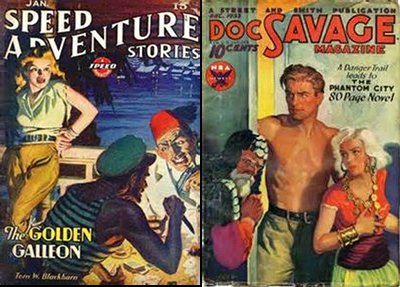
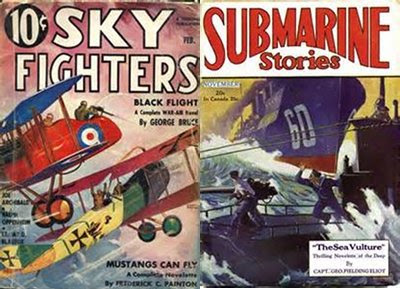
The similarities extend beyond price, volume, and profits. It's reflected in content as well. As I mentioned above, the pulps offered stories for every reader, every interest and taste. There were pulp magazines devoted to railroads, air planes, submarines, zeppelins, ships and the sea, cowboys, detectives, gangsters, science fiction, fantasy, horror, boxing, sports, and all types of romance stories. Indie-published ebooks offer the same sweeping spectrum of stories for every taste, no matter how obscure.

The distribution model of pulps and ebooks also share the distinction that, unlike traditionally published books, you're not likely to find them in bookstores. The pulps were sold on newsstands, in drug stores, and in other non-traditional book venues. Today indie-ebooks, POD print books, and audio books are mostly sold online, rarely finding their way into bookstores.


Indie-ebooks and pulps share more than just a similar market. Their subject matter, writing styles, and writing philosophy are very similar as well. Of course there is a wide variety of small press and indie-published books, many of which don't follow the pulp formula, yet it seems that many of the most successful ones do. Readers of both the pulps, and indie-published ebooks, tend to be story orientated readers rather than style orientated ones. The great secret in publishing is that many readers are not all that fussy when it comes to how stories are written. If the story draws them in, and they find it entertaining, they'll turn a blind eye to how well it's written. “Pot boilers” have always sold well. Moreover, not only do readers value stories more than writing, they like the familiar. Stories written in familiar formulas are welcomed, rather than despised. Much of the advice given to aspiring indie-writers promote the pulp, formula of writing. Give them stories you know they like – research your market. Write fast, one draft if you can. Write short, 50K word novels, short novellas, and short stories. Publish frequently to keep readers engaged. Find a formula that works and stick with it. And write series, where not only the formula, but the characters are familiar. I'm not saying that this style is universal in indie-writing, only that it makes up a good portion of the commercially successful indie-ebooks exactly because it appeals to the same type of reader that was attracted to the pulps in their day.


Some pulp writers, like indie-writers, found great commercially success, despite the fact that neither the pulps or indies stories are reviewed in the mainstream media. In the hay day of pulps, there were pulp writers making movie star incomes, just as there are millionaire indie-writers today. And, like today's indie-authors, many new writers wrote for the pulps before moving on (or “up”) to traditional publishing – just like the many successful indie-writers do today. Conan Doyle, Edgar Rice Burroughs, P G Wodehouse, Raymond Chandler, Ray Bradbury, and H P Lovecraft, just to name a few started their careers writing for the pulps. Like their modern counterparts, pulp writers sold their work in many formats from traditional books to Hollywood screen plays, like today's hybrid writers and indie-writers who diversify into POD books and audio books. The first Tarzan movie came out only a few years after it appeared in the pulps, like The Martian today. This entrepreneur spirit, is a feature of both the successful pulp and indie author
.
There are, of course, many differences as well. Pulp writers, for example, wrote for a much smaller audience – pulp magazine editors. The magazines offered an established brand and provided services like editing and story guidance, ideas, proofreading, and marketing at no charge to the writer. The magazines, being anthologies, helped new writers reach readers and convey credibility by their association with both the magazine and its more well known contributors. These days, indie-authors must pay for many of these services out of pockets– and bear the financial risks involved in publishing as well.


Despite the differences, it seems to me that the indie-publisher today is the direct descendant of pulp writers of the past. And that their markets are functionally the same. If that is the case, then the indie-published ebook market should be viewed as something distinct and different from the tradition print book market – not only in form, but in function as well.

So what?

Well, for the indie-writer it may mean looking at their business a bit differently, since it's a different tradition with, perhaps, a different future than traditional book publishing. Traditional book publishers might want to take a hard look at their position in that market with a historical perspective. They co-existed with, and survived long after the pulp market died off. They may not be able to outlive the indie-ebook market, but they can almost certainly co-exist with it.


The question then arises, do they need to compete in the ebook market at all? They left the pulps be pulps, so could they not turn a blind eye on ebook publishing as well? Given that they make something like 1/3rd of their incomes comes from ebooks, the answer might be a “No!” – if it meant abandoning that income entirely. But does it? If a publisher has a stable of proven, popular authors, wouldn't these authors draw most of their readers back to the print, if that was their only option (at least on first release)? How many ebook customers of traditionally published ebooks are entirely committed to reading ebooks and only ebooks? Is there not still time to draw a line between “books” in paper, and indie-published ebooks or in effect,“ePulps”?

Given that the (discounted) price of the paper edition is not much more than the agency ebook price, any resistance to this change would likely arise only from the format rather than price. I would argue that as of today, that risk seems modest. So, with the modest risk of leaving a few customers behind, traditional book publishers would create the opportunity of redefining both ebooks and print books. By exiting the ebook market, at least for hardcover and trade paperbacks, they could then draw a bold line in the sand. They could then make the case (rightly or wrongly) that there is a clear distinction between “real,” traditionally published authors, who write “real” books that are carefully selected and edited for a quality reading experience, vs the non-curated indie-published, “ePulps”, rejected stories written by beginners and amateurs, and published in great numbers on the cheap. And by removing their hardcover and trade paperback library from their ebook offering, they would drive business back into the business they know best – paper publishing.

Still, they need not abandon the ebook market entirely. They could release the ebook versions of their “real” books a month or two after the book's mass market paperback release, priced competitively with indie ebooks, say $5.99 or less. In this way they would eventually reach every potential customer; from the eager hardcover buyer to the budget reader willing to wait for the cheap ebook, without diluting the idea that traditionally published books are fundamentally different from indie-published “ePulps.”

While I'm playing the devil's advocate here as far as what traditional publishers might think and do in the ebook market, I feel comparing indie-publishing to pulps is valid. A lot of people think the big five publishers are shooting themselves in the foot with their high prices for ebooks, but they may just be too timid. Yes, the higher prices set them apart from the indies, but by withdrawing their newest, most in-demand books, they might make that distinction even sharper. In the past there was a distinction between “pulp writers” and “paperback writers” and published authors of "books." Fair or not, they could make that distinction again, and reinforce it by keeping their authors out of the indie-writers' ebook market, and perhaps secure a mindset for their paper books for many decades to come.


There are many people who say that ebooks are the books of the future, and if traditional publishers don't embrace change, they are doomed for irrelevance down the road. I'm old enough to know, that, even if they are right, it's unlikely happen before we're all driving flying cars. And when you consider that cassettes, eight-track, CDs, itunes, and streaming music services haven't managed to push vinyl records into the dumpster of history (They're Back!), I have to believe that paper books have a long, long future ahead of them no matter what. Indeed, since ebooks are dependent on digital technology, which changes very rapidly, I'd say that one should wonder more about the staying power of ebooks than that of paper books.

For information on the pulps I consulted The Pulps, Fifty Years of American Pop Culture, edited by Tony Goodstone, researched consultant: Sam Moskowitz