Books By C. LItka

Books By C. LItka

Saturday, August 5, 2023

The Saturday Morning Post (No. 7)


This Saturday I am reviewing, discussing, and contrasting two British authors' attempts to write light, humorous stories, namely Dornford Yates and P G Wodehouse.

My reviewer criteria. I like light, entertaining novels. I like smaller scale stories rather than epics. I like character focused novels featuring pleasant characters, with a minimum number of unpleasant ones. I greatly value clever and witty writing. I like first person, or close third person narratives. I dislike a lot of "head jumping" between POVs and flashbacks. I want a story, not a puzzle. While I am not opposed to violence, I dislike gore for the sake of gore. I find long and elaborate fight, action, and battle sequences tedious. Plot holes and things that happen for the convenience of the author annoy me. And I fear I'm a born critic in that I don't mind pointing out what I don't like in a story. However, I lay no claim to be the final arbitrator of style and taste, you need to decide for yourself what you like or dislike in a book.

Your opinions are always welcome. Comment below.


Berry And Co. by Dornford Yates  DNF 32% (up to chapter 5)

Berry and Co is a 1920 collection of short stories featuring five cousins, the namesake, Berry i.e. Major Bertram Pleydell who is married to his first cousin Daphne, plus Daphne's brother Boy Pleydell,(the first person narrator) plus Jonathan (Jonah) Mansel, along with Jonah's younger sister Jill, all of which, I must admit seems a bit strange, if not a little creepy cast of characters. But I guess if marrying a first cousin is good enough for the royalty of Europe, its good enough for this upper class cast of humous characters. The book is a collection of short stories originally published in The Windsor Magazine, a monthly literary magazine of the time. My copy of the book is a Gutenberg ebook version.

The premise of the story is that these cousins are wealthy enough to not have to work, at least as far as I could tell from the limited number of stories that I've read. The series began in the pre-war world of 1914, and the series continued after the war, once the men had returned from war, in which Berry we know had been an army officer. The stories in this book take place after the war, as they are reestablishing themselves in society. The stories are very light. For example the first one has them all together at the family home "White Ladies" on a Sunday for the first time in five years. They go to church, during which their new acquired 1914 Rolls Royce is stolen (you apparently didn't need keys to start a 1914 Rolls) despite having asked a fellow watch over it for them. Boy, with the help of a girl in a car, trace the Rolls in her car (until it runs out of gas) and spot it parked in front of an inn. They take off with it - only to discover upon arriving home that their own Rolls had been found previously, it being very short of petrol hadn't been driven far, so that they had actually stolen someone else's identical Rolls. Then the police then arrive with the second car's owner... You get the idea.

Since I didn't finish the book, you can correctly assume that I did not find these stories as amusing as they were intended to be. Humor's that way, some of it works, some doesn't. It all depends upon the recipient. Given that, I thought it might be interesting to talk about why this is, by comparing it to another British author of Humorous stories, P. G. Wodehouse. To better compare them, I picked a Wodehouse book off my shelf and read it. A quick review below, and then the discussion of why one worked, and the other didn't.


Heavy Weather by P. G. Wodehouse  B+

This is the 5th book in Wodehouse's Blandings Castle Saga of 11 novels and nine short stories. Blanding Castle is the home of the prize fattest pig obsessed Lord Elmsworth, his sister Lady Constance, his younger gadabout brother, the Honorable Galahad Treepwood, who are all faithfully served by their butler, Beach. And into this venerable English country estate, where it's always summer, comes a host of Wodehouse characters, many of them drawn from the Drones Club, as well crooks, private investigators, plus other sundry characters. 

In this case we have Monty Bodkin, who has to hold down a job for a year to marry get his sweetheart's father's approval for marriage, Ronny Fish who needs Lord Elmsworth to release some of the money held in trust for him so that he can marry his true love, the ex-chorus girl Sue Brown, a wedding opposed by his mother, Julia Fish, sister to Constance, Elmsworth, and Galahad. She and her sister Connie hope to browbeat Elmsworth into not giving Ronnie the money and nix the marriage. And then there is the memoir of Galahad, who, along with most of the now peers of the land, was a man about town in the 90's and whose stories about the antics of the now respectable people in those days would cause an outrage amongst his peers. Constance and Julia hope to keep the manuscript suppressed (as it was in the previous installment of the saga) while the publisher, Lord Tilbury hopes to steal it and publish it, as originally promised... And being Wodehouse, it get pretty involved...

This book is not an apples to apples comparison to Berry & Co. as it is a novel, not a collection of short stories, and not a first person narrative. The Bertie Wooster short stories would be a more apples to apples comparison, but I had reread some of those in the last year or two, so I chose this book more or less randomly off the shelf to read to refresh my impression of Wodehouse, though I am fonder of his Bertie Wooster stories.

The contrast between Yates' stories and Wodehouse's stories could not be, in my opinion, greater, despite sharing more or less the same premise; they feature the lighthearted misadventures of people many of whom have inherited enough money to live on without having to work. There are several factors that contribute to this contrast.

The first difference between the two writers, is that the characters of the Yates books are portrayed as adults. Berry is an (ex?)army major, and one would have to assume to be at least middle aged. In contrast, while Wodehouse's protagonists while university educated young men about town, retain a rather carefree, if not juvenile attitude. The female cast of characters vary greatly, from the young, often independent, pretty women who the Drones Club members inevitably fall in love with, to the formidable aunts who these members must get around to marry their true love. There is an air of youthful cheerfulness in these Wodehouse characters that somehow seems lacking in the Yates cousins. Yates' cousins come off as, well, wealthy, idle, and bored snobs. While some members of the Drone Club may or may not be wealthy and many are often idle, living on inherited money like Bertie Wooster, others have to work as tutors or private secretaries, at least until their quarterly allowances, which they lost on unfortunate horses, is paid, and as often as not, get sacked before it does. They come across as far more likeable, if perhaps less likely, chaps than the company of Berry & Co. They are people you would like to believe could exist.

And while Yates' short stories are somewhat similar, Wodehouse's are usually far more involved. Which brings us around to the writing. Yates' humor relies on having his characters use witty/silly dialog. Take this example, Here is Berry describing his time in a local jail; 

'How did you spend your  time?' said Jonah.

'B-b-beating my wings against the crool b-b-bars,' said Berry. 'My flutterings were most painful. Several turnkeys broke down. The rat which was attached to me for pay and rations gambolled to assuage my grief. Greatly affected by the little animal's antics, I mounted the plank bed and rang the b-b-bell for the b-b-boots. In due course they appeared full of the feet of a gigantic warder. I told him that I had not ordered vermin and should prefer a fire, and asked if they'd mind if I didn't dress for dinner. I added that I thought flowers always improved a cell, and would he buy me some white carnations and a b-b-begonia. His replay was evasive and so coarse that I told the rat not to listen, and recited what I could remember of "The Lost Chord."' He turned to me. 'The remainder of my time I occupied in making plans for the disposal of your corpse.'

Berry, at least, and the others as well, often ask or answer questions with such flights of fancy, being bright, carefree people of the post war jazz age. They were popular stories, so I am sure some people, and perhaps you as well, might find them funny. There are several books of these stories on the Gutenberg project for free if you think you might. 

Wodehouse's humor is more intricate and often grounded in slang. Take this passage I choose amongst half a dozen I found within a minute of opening the first pages of The Inimtable Jeeves between Bertie and Bingo Little.

'Jeeves tells me you want to talk to me about something,' I said.

'Eh?' said Bingo, with a start. 'Oh yes, yes. Yes.'

I waited for him to unleash the topic of the day, but he didn't seem to want to get going. Conversation languished. He stared straight ahead of him in a glassy sort of manner. 

'I say, Bertie,' he said, after a pause of about an hour and a quarter.

'Hallo!'

'Do you like the name of Mabel?'

'No.'

'No?'

'No.'

'You don't think there's a kind of music in the word, like the wind rustling gently through the tree-tops?'

'No.'

He seemed disappointed for a moment; then cheered up. 

'Of course, you wouldn't. You always were a a fat-headed worm without any soul, weren't you?'

'Just as you say. Who is she? Tell me all.'

For I realized now that poor old Bingo was going through it once again. Ever since I have known him - and we were at school together - he has been perpetually falling in love with someone, generally in the spring, which seems to act on him like magic. At school he had the finest collection of actresses' photographs  of anyone of his time; and at Oxford his romantic nature was a byword.

'You'd better come along and meet her at lunch,' he said, looking at his watch.

'A ripe suggestion,' I said. 'Where are you meeting her? At the Ritz?'

'Near the Ritz.'

He was geographically accurate. About fifty yards east of the Ritz there is one of those blighted tea-and-bun shops you see dotted about all over London, and into this, if you'll believe me, young Bingo dived like a homing rabbit; and before I had time to say a word we were wedged in at a table, on the brink of a silent pool of coffee left there by an early luncher.

Bright, brisk, with a bit of silliness in the slang of his characters, while still being grounded in characters and indeed, a world, which you would very much like to believe once existed. 

And perhaps the greatest difference is that Wodehouse tells the entire story with a great deal of dash, cleverness, and humor, whereas Yates tells it with a light touch, but with an ordinariness that is broken by the occasional flights of fancy and silly/faux clever dialog that strikes me to be out of character for his characters.

Humor is very subjective, so that if you should find Berry and Co. funny, I can't find fault in that. Sadly, I didn't.

Wednesday, August 2, 2023

The Blandings Castle Saga


I have, quite by chance, undertaken the reading of P. G. Wodehouse's "Blanding Castle Saga." I plan to review the individual books in my The Saturday Morning Post, so in this post I'll just outline the setting of the saga, the castle that gives it's name, its usual inhabitants, mention some of the guests, many of whom arrive as imposters, and livestock. I owe a lot of the information on Blandings itself to the 1977 hardcover book, Sunset at Blandings, which includes Wodehouse's last and unfinished Blandings story, along with a map and house plan of Blandings Castle drawn by Ionicus with an accompany essay on the setting by Richard Usborne.

So to begin, with a warning to authors;

'...there is nothing an author to-day has to guard himself against more carefully than the Saga habit. The least slackening of vigilance and the thing has gripped him. He writes a story. Another story dealing with the same characters occurs to him, and he writes that. He feels that just one more won't hurt him, and he writes a third. And before he knows where he is, he is down with a Saga, and no cure in sight.' P G Wodehouse in the preface to Blandings Castle.

A Blandings Castle novel always includes the castle's proprietor, the absent minded Lord Emesworth, often his equally empty headed son Freddie Treepwood, his domineering sister Aunt Connie, his butler Beach, sometimes his sinister secretary, the Efficient Baxter, and the later stories, his pig The Empress of Blanding. 

The books below listed in reading order constitute Wodehouse's second greatest saga, after the Bertie Wooster and Jeeves saga.    

Something Fresh (1915) (aka Something New in America)

Leave it to Psmith (1923)

Blandings Castle  Includes six short stories written between 1924 to 1931; The Custody of the Pumpkin, Lord Emsworth Acts for the Best, Pig-hoo-o-o-o-ey, Company for Gertrude, The Gogetter, and Lord Elmsworth and the Girl Friend

Summer Lightening (1929)

Heavy Weather (1933)

"The Crime Wave at Blandings" (short story, 1937)

Uncle Fred in the Springtime (1939)

Full Moon (1947)

"Birth of a Salesman" (short story 1950)

Pigs Have Wings (1952)

Service with a Smile (1961)

Galahad at Blandings (1965)

"Sticky Wicket at Blandings" (Short story 1966)

A Pelican at Blandings (1969)

Sunset at Blandings (1977) an untitled novel which Wodehouse was in the process of writing on his death bed.

They are all stand alone books in that they can be read and enjoyed in any order, though references to earlier incidents may be included. Below is Blandings Castle from the air, as drawn by Ionicus, who illustrated the Penguin books in the 1960 & 70's, and who I consider the definitive P G  Wodehouse illustrator.  

Blandings Castle

Blandings Castle and its cast of characters are firmly set in the Wodehouse "universe." While I don't think Bertie and Jeeves were ever a guest at Blandings, an Emsworth a maybe cousin of sorts, Algernon Wooster did stay there in Something Fresh (or New, if you have the American book). And readers familiar with many members of the Drones Club will find familiar names amount the guests, including Monty Bodkin, Ronnie Fish, Hugo Carmody, Rev. Rupert "Beefers" Bingham, and Pongo Twistleton. Psmith, in Leave it to Psmith, is also a member, and who was an early Wodehouse character first appearing in a boy's story Mike and Psmith, and then went on to star in two earlier books, Psmith in the City, and Psmith Journalist, before arriving at Blandings Castle in the guise of the Canadian poet, Ralston McTodd. 

Below is a map of Blandings countryside, and of the various locales mentioned in the books. Hopefully if you click on it, it will come up large enough to explore.

Blandings Castle, Grounds, & Surrounding Countryside

Blandings Castle is set in the west of England, in the county of Shropshire, a four hour train ride from London's Paddington Station. Wodehouse found it a slightly inconvenient locale in that he couldn't have his characters easily popping up to London to do something and return in the same day in time for dinner.

Blandings Castle is said to be one of the oldest inhabited houses in England. It "stands  upon a knoll of riding ground at the  southern end of the celebrated Vale of Blandings in the country of Shropshire. Away in the blue distance wooded hills ran down to where the Severn gleamed like an unsheathed sword; while up from the river rolling park-land, mounting and dipping, surged in a green wave almost to the castle walls, breaking upon the terraces in a many-colored flurry of flowers as it reached the spot were the province of Angus McAllister, his lordship's head gardener, began."

On the map above you will note some of the major features mentioned in the book, including the old and new pig sty, the residence of Lord Emsworth's prize winning pig, The Empress of Blanding, the lake where Lord Emsworth makes it a habit to bath each morning in summer, the mossy Yew Alley that Angus MacAllister would like paved with gravel, and in the upper right corner, Market Blandings, where the train from London stops, some two miles from the castle.

Market Blandings is said to be the perfect quaint old English town, almost untouched by the passing of time. Market Blandings's Elmsworth Arms is the favorite inn in the saga, though the little town also offers excellent beer at the Wheatsheaf, the Wagoneer's Rest, the Beetle and Wedge, the Stitch in Time, the Blue Cow, the Blue Boar, the Blue Dragon, and the Jolly Cricketers, and several more. "In most English country towns, if the public-houses do not actually outnumber the inhabitants, they all do an excellent trade. It is only when they are two to one that hard times hit them and set the inn-keepers blaming the Government."

The proprietor of Blanding Castle is the ninth Earl of Emsworth, Clarence Treepwood, best known as Lord Emsworth. He is "normally as happy as only a fluffy-minded man with excellent health and a large income can be. A writer, describing Blandings Castle in a magazine article had once said 'Tiny mosses have grown in the cavities of the stones until, viewed near at hand, the places seems shaggy with vegetation.' It would not have been a bad description of its proprietor. Fifty-odd years of serene and unruffled placidity had given Lord Emsworth a curiously moss-covered look. Very few things had the power to disturb him. Even his younger son, the Hon. Freddie Treepwood, could only do it occasionally" However, it has to be said that in the books he is often disturbed by the various alarms and excursions of the castle's guests who arrive, often as imposters, for various reasons. It is sad to say that when I first read these stories, Lord Emsworth was a rather absent minded 60 year old man, and now as I reread these stories, what the fuck, he's 13 years my junior. That's dashed sad.

The Blandings Castle Saga is, unlike the Bertie Wooster stories, told in third person, and while on the whole I prefer the Bertie Wooster stories, especially the early ones, I find that I am enjoying these tales perhaps even more than when I first read them. That said, I am going to have my work cut out for me when I get around to writing the reviews of each, as while a great deal happens in each story, they all follow a very similar pattern; true love foiled by a lack of money and/or the opposition of Aunt Connie. It seems that Lord Elmsworth is the trustee for various nieces and nephews and so the needed capital for the proposed onion soup bar, to get married, or what have you, must be pried out of him, usually over the objections of his sister, Aunt Connie and usually because of the unsuitability of the prospective marriage due to class prejudice.

As I said, there is a pattern to these stories, despite being extremely intricate when it comes to plot. I found that I was missing two of the later books, so they are now in the mail as I post this. More about Blandings in the Saturday posts coming in a few weeks.

Another version of Blandings Castle


Saturday, July 29, 2023

The Saturday Morning Post (No.6)


I've a grab bag of books to review this week, starting with Baroness Orczy's The Scarlet Pimpernel, which I wanted to read to see if it was indeed, Batman with swords which the Wikipedia made it out to be. Let's get right into it.

My reviewer criteria. I like light, entertaining novels. I like smaller scale stories rather than epics. I like character focused novels featuring pleasant characters, with a minimum number of unpleasant ones. I greatly value clever and witty writing. I like first person, or close third person narratives. I dislike a lot of "head jumping" between POVs and flashbacks. I want a story, not a puzzle. While I am not opposed to violence, I dislike gore for the sake of gore. I find long and elaborate fight, action, and battle sequences tedious. Plot holes and things that happen for the convenience of the author annoy me. And I fear I'm a born critic in that I don't mind pointing out what I don't like in a story. However, I lay no claim to be the final arbitrator of style and taste, you need to decide for yourself what you like or dislike in a book.

Your opinions are always welcome. Comment below.


The Scarlet Pimpernel by Baroness Emmuska Orczy Orczy  C+

Let's address the elephant in the room, this proved not to be Batman with swords. Indeed, not only does the title character play only a minor role, on stage anyway, in most of the story, but there is not one sword fight, indeed, not one fight scene at all. So what is the story about?  Well, the Wikipedia entry states;

The novel is set during the Reign of Terror following the start of the French Revolution. The title is the nom de guerre of its hero and protagonist, a chivalrous Englishman who rescues aristocrats before they are sent to the guillotine.... (who is) a formidable swordsman and a quick-thinking master of disguise and escape artist. The band of gentlemen who assist him are the only ones who know of his secret identity. He is known by his symbol, a simple flower, the scarlet pimpernel.

Luckily for me, I did not reread this summery before I read the book, so I forgot who they identified as the Scarlet Pimpernel, (I've edited it out for you) and so I learned who it was, more or less as the Baroness intended, though before it was actually revealed. That made the story a bit more interesting. My advice forget the summery in its entirety, as it does not describe the book in any meaningful way.

The story is largely set in 1792 England, and the main point of view character is a former French actress, Marguerite Blakeney (nee St Just), the wife of a very rich and very oafish English aristocrat Sir Percy Blakeney - though it takes a couple of chapters of set up to get to her and Sir Percy who is an intimate friend of the Prince of Wales, i.e. one of the in crowd. Their marriage has fallen on ill times, though Sir Percy treats her with great respect, he would seem to have ceased to love her, and she him.

The plot centers around Marguerite, whose dear brother, is working with the Scarlet Pimpernel to smuggle aristocrats out of France during the reign of terror, even though he is both French and not an aristocrat. Indeed, having been beaten to a pulp for sending a note to the aristocratic girl he loved, he is a believer in the revolution, but feels that it has perhaps gone too far. In any event, his involvement with the Scarlet Pimpernel is discovered by a French agent in England and is used to blackmail Marguerite into helping him discover identity of the Scarlet Pimpernel and capture him while he is in France, as he rushes to save Marguerite's brother and the French aristocrats that the Marguerite's brother went back to France to help escape as part of the Scarlet Pimpernel's gang of helpers.

After the introduction of the setting and characters in the first couple of chapters, the story revolves around Marguerite's struggles to save her brother at the cost of betraying the identity of the Scarlet Pimpernel, and then her attempts to save him herself. It is rather overwroughtly written by today's standards, but I enjoyed it, even though it was not what I expected. I believe that there are something like 19 novels concerning the exploits of the Scarlet Pimpernel and members of his band of adventures, so maybe they include some sword fights. At least several are available from the Gutenberg Project where I downloaded my version of the story, so I might give them a try some day. We'll see. 


When the Tiger Came Down the Mountain by Nghi Vo  C+

This is a fantasy novella set in a fantasy version of China with were-animals, in this case weretigers. The story concerns a traveling cleric/scholar Chih who is escorted to a way station in a snowy mountain pass by a Si-yu, a scout who rides a mammoth. At the station they are confronted with three weretigers who intend to eat them, and Chih must tell his version of a love story between a human and a weretiger to the weretigers who, in turn, have their own version of the story to relate, in order to keep the tigers from attacking and eating them. Each learns from each other different aspects and different attitudes of the characters and the story as they knew it. It is a quick read of 80 pages, and is set in a world first introduced in her novel, The Empress of Salt and Fortune, and now includes a second novel, Into the Riverlands. I believe Chih is the central storyteller who links all the books of the Singing Hills Cycle of which Mammoth at the Gates will be the fourth. While I can not say for certain, since I have not read either of the other stories, I suspect that this series may follow the blueprint of Ernest Bramah's Kai Lung stories set in a fictional China that have Kai Lung relating stories to bet himself out danger, but I could be entirely wrong.

I have this story only because it was one of the free books TOR.com offered, no doubt to promote Into the Riverlands when it was released. In any event, if you like weird tales of sort of China with magical creatures, then you should like these books. 


John Burnet of Barns, A Romance by John Buchan  C+

This is Buchan's second novel, written when he was 23. It is a historical novel largely set in 1680's in the low lands of Scotland, with a brief section in Holland. This was a time of great religious strife in Scotland between the Scottish Calvinist dissidents and those upholding the official state religion of the Church of England and it saw the king's soldier hunting down these diehard dissidents for treason. The hero of the story, John Burnet falls afoul of his elder cousin, and after besting him a duel in Holland where the cousin was a captain in a band of mercenaries. On the cousin's return to Scotland where he pursues John's true love and spreads lies that has John branded as a traitor. John returns to Scotland to save his love and clear his name.

There is nothing Buchan likes better than describing the scenery of Scotland, and having his hero a hunted man, gives him great scope for doing so. He also paints a vivid picture of the time and place with a story filled with desperate action. A fine, authentic historical novel written in the style of 1898 if that's to your taste.

The Half Hearted by John Buchan  D

This is Buchan's fourth novel, written when he was 24 and tells the story, in two parts, of a very accomplished upper class young man, heir to an estate in Scotland, Lewis Haystoun, who doesn't fit in with modern society. He is not driven, too good natured, doesn't know what he wants to do with his life and so is unable to commit to anything with his whole heart. The first part of the story, relates an ill fated romance, where his indecision, and in his view "cowardice," prevents him from wining the girl he loves, and who loves him as well, plus losing an election to parliament. The second half sees him traveling to the frontiers of India and foiling a plot to invade and start a native uprising there.

I have to feel that Buchan had ambitions for this book to be "important", since he spent great deal of words expounding on his philosophy of live by putting the words into the mouths of his various characters. Buchan, was a brilliant person, the son of a Scottish church minister, he won scholarships and awards, graduating from Oxford and going on to become the private secretary of a high British government official in South Africa for three years before returning home to become the editor of the Spectator Magazine and write more novels. He ended up governor general of Canada in the late 1930's. All the photographs of him I could find all show a tight lipped grim looking man. Thinking back, I have to admit that most of his books have a great deal of "intellectual" weight to them and that his heroes all tend to be the type of people that George MacDonald Fraser's Flashman would think fools; upper-class, idealistic, self sacrificing, very pro-British Empire, foolishly brave fools and knaves who built and maintained a colonial empire for several hundred years. At the end of the story, his half heartedness lost in his determination to save the British Empire in India, Lewis Haystoun becomes one of them.

I found the story a bit too "important" and ended up skimming a lot of book two of the story as it contained a lot of talk, long descriptions of the landscape and everything the hero did, as well as social comments that are long out of date. Plus the "threat" to the British Empire seemed too silly for me to take seriously. In short, I would not recommend this Buchan story to modern readers. His best one is The 39 Steps, and if you like the hero of that one, he appears in three more books written over several decades.


Honor of Thieves by C. J. Cutcliffe Hyne  B (Republished as The Little Red Captain)

I found this book on my ebook reader, and while Hyne is one of my favorite writers, it didn't ring a bell - until I started reading it. It proved to be the first Captain Kettle story, a book I had read in paper many years ago, so my read turned into a reread. 

I should say right at the start that if you are sensitive to racism, racist stereotypes, and nationalities referred to in the most demeaning terms, save the English in print, you should steer well clear of the Captain Kettle stories. The character of Captain Kettle is that of a tough, sharp tongued tramp ship officer who has to deal with crews that are composed of hardboiled characters, and does his job by ruthlessly dominating them with sheer will power and a belief that the English race is superior to all other races and nationalities. He makes that clear in how he treats everyone not English, white or not, at least in words, if not action. I do not know how much of the racism is a reflection of Hyne's attitude and how much is his effort to make his character authentic. In any event, I can accept this attitude as a reflection of the time in which it is written and the type of character the story centers on. I think it's an accurate portrait of the racism of 1895 and take heart in the fact that while we still a long ways to go for all people to view all people as one people, this type of book illustrates the fact that progress is being made, if not as fast as we would like.

The story involves a shipowner, Theodore Shelf, whose business is going under, in part due to the extravagance spending of his wife. She is bent on climbing the social ladder by having him made a peer. He meets a well educated and well traveled man, Patrick Onslow who knows of an undiscovered river where a ship may enter the Florida everglades, which in 1895 was a wilderness still inhabited by Indians, alligators and mosquitos. Onslow proposes to use this discovery to offer hunters access to the everglades using a ship as a home base, and then sell the land to would-be orange growers. Shelf, needs more money than that, and quicker, so he proposes another plan involving faking the sinking of one of his ships for the insurance money on the ship and its cargo. Captain Kettle, with an undeserved bad reputation, is hired to oversee the dirty work.

In this story Captain Kettle is a supporting character, but after this story was first published Pearson's Magazine, in an English monthly literary magazine, the editors asked Hyne to write more stories featuring Captain Kettle, which he did over the next few year, and continued to do so for until 1938, along with stories featuring a number of other nautical characters.

Coming next week, a review of two books by British writers of humorous stories and novels along with a brief discussion of how and why humor works and doesn't.

Wednesday, July 26, 2023

35,301 Paintings (And Counting)

A painting by George Ames Aldrich

There are two things I've always enjoyed doing, painting, and writing stories. I've done both of those activities off and on for most of my life. I have a closet full of paintings, at least 1500 of them of various sizes and styles, that are worth millions of dollars, if my kids play their cards right once I'm dead. (See Upton Sinclair's Lanny Budd books.) Alas, over the last five years my output of paintings as diminished to the point were I was only painting covers for my books, and that only begrudgingly, and not very well, either. With my story writing seemingly winding down, I'd like to get back into painting, and to that end, I've been surveying the world of art to get that set of creative juices flowing once again.

That survey of art has taken the form of watching slide shows of paintings from the vast collection of the Learn from Masters video collection of paintings. It includes work from over 800 painters, some of which are represented by only several dozen paintings, while others have hundreds or more. Each painting is shown for something like 6 or 7 seconds, though you can pause the video if you care to to study a painting longer. I, on the other hand, am only trying to get an overview, a feel for art again, and perhaps absorb in some intuitive manner what works and what doesn't, so I play the videos at 2X speed, viewing each painting for only 2 to 3 seconds. Some painting deserve a lot more time and attention, and others, less, I'm not trying to study art, but experience it. So far I've viewed 35,301 paintings from a mere 260 different artists.

Ideally, the paintings would be arranged chronologically so that you could see the evolution of the artist. But given the sheer number of paintings this person has assembled, I'll not complain that they are in rather random order. It would be nice if they were titled, but again, given the sheer numbers... The other problem inherent in the presentation is that all the paintings are more or less the same size. A painting could be 7 inches wide or 7 foot wide and both would appear to be the same size on the screen. This is unavoidable. However, since both finished paintings and small field studies are presented in more or less the same size, it is sometime difficult to know what the artist intended the painting to be. Was the artist painting in an impressionist style, or are we're seeing just the preliminary plein air painting made on the scene for use as a reference in producing a finished work completed in the studio. Below is an example of what I believe is a study:

And here is the finished work:

 Both painting by Maximilien Luce

Sometimes the paintings are clearly quick studies for a larger work, but sometimes they stand on their own as a completed painting. In the case above what appears to be the study was shown in the presentation after the finished one, but close enough in the series that I recognized it as more or less the same painting I'd seen earlier. When you can see both the study and the finished product, you can see how a painting is developed. 

I have a number or art books on impressionist painters, so every now and again I'll come across a painting from a less famous artist that I recognize. Plus it is nice to see more than one example of their work to judge them by.

I am a landscape/cityscape/seascape sort of person, so those are generally my favorites, but I do enjoy seeing portraits as well, especially when well executed. and there are plenty of them in many collections. And because these paintings can date back something like 200 years, they offer the viewer an authentic glimpse of  the life of the people of bygone eras, as well as taking the viewer to exotic locales, some real, other imagined.

Here are some other things I've learned so far.

There are a lot of paintings and a lot of artists. With 800+ artists, there could be a 100,000 paintings to view.

Kylie Cows Watering by William Langley

Cows are aquatic animals. Many of the old landscapes that have lakes also have cows knee deep in them. Who knew?

Watercolor  by William Russell Flint

It seems that it was common for young women to gather and skinny-dip. Or so a lot of painters would have us believe. I suspect this was either wishful thinking or a fringe benefit of being an artist. What a racket.

Grand Canal Venice by Thomas Moran
Every painter, it seemed, painted Venice.

Docks of Paris Les Quais by Eugene Galien-Laloue

 And Paris. 

London by Giuseppe de Nittis


And London. Which is fine, they are interesting places.

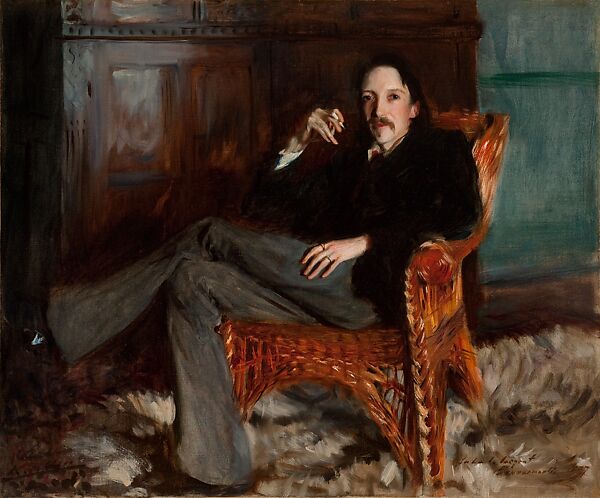
Robert Lewis Stevenson by John Singer Sargent

Many, if not most artists, painted portraits. I suspect because those commissions paid the bills.

Benefits Supervisor Sleeping by Lucian Freud

Many, if not most artists, painted nudes. It was considered classic "art." Right. As I said, quite a racket.

There are, indeed, such things as masterpieces. Many times when going through a collection I will come across one or two paintings that just seem to stand out from all the rest - a combination of the right scene, lighting, colors, and execution. They are, however, rare, which is what makes them masterpieces.

I should've been taking notes, but I didn't, and now it's too late now.

Some people keep track of how many states they visit, or foreign countries. I'm going for how many paintings and drawing I've viewed.

In addition to these paintings, I'm currently up to date on installment no. 98 of Pete Beard's survey of forgotten illustrators that you can find here. In each of these segments he highlights the work of 4 illustrators in each 15 minute or so installment. I haven't counted how many pieces he shows, as it varies according to the amount of source material he has to work with, but between them and the special shows of a single artist or style, they could easily add another 5,000 paintings and drawings to my total.

Illustration for books and posters is another facet of art which I find fascinating. In many cases, I really like the illustrator's approach to a subject, though I like some countries' illustrators more than others. As I said, all fascinating stuff.

Stanley R Badmin advertising art

We'll have to see if it pays off.

Saturday, July 22, 2023

The Saturday Morning Post (No. 5)


This post offers two more reviews of the books by British woman from the Furled Middlebrow collection; the best, and the most disappointing of the lot. Let's start with the most so-so book of the lot and finish with the best, but first my customary disclaimer...

My reviewer criteria. I like light, entertaining novels. I like smaller scale stories rather than epics. I like character focused novels featuring pleasant characters, with a minimum number of unpleasant ones. I greatly value clever and witty writing. I like first person, or close third person narratives. I dislike a lot of "head jumping" between POVs and flashbacks. I want a story, not a puzzle. While I am not opposed to violence, I dislike gore for the sake of gore. I find long and elaborate fight, action, and battle sequences tedious. Plot holes and things that happen for the convenience of the author annoy me. And I fear I'm a born critic in that I don't mind pointing out what I don't like in a story. However, I lay no claim to be the final arbitrator of style and taste, you need to decide for yourself what you like or dislike in a book.

Your opinions are always welcome. Comment below.


Babbacombe’s by Susan Scarlett C

Each of the 72 books Furrowed Middlebrow they have published feature an introduction by Elizabeth Crawford describing the author, their work, and the novel at hand. In this case we learn that, Susan Scarlett is the pen name of Noel Stretfield (1897 – 1986) a prolific writer whose 40 year career spanned several genre, including children’s novels in her own name and pen names.

This story concerns the Carson family, with a focus on Elizabeth Carson, the eldest daughter. Mr Carson has been employed at Babbacombre’s department store, and with her graduation from school, Elizabeth starts her first job there as well. Unfortunately, they were asked to board an orphaned niece of Mr Carson, the daughter of a half-brother that he could not stand. She turns out to be very unpleasant as well, nevertheless he gets her a job at Babbacombre’s as well. She chooses to be an elevator operator, as it is an easy job, though without a future, but she has a private income of sorts, so she doesn’t mind. You see, she has no intention of working all her life when there are rich men to be found.

I opted to try this one largely based on the cover, a cutaway of a department store, thinking that a lot of the action would take place in the workplace, but alas, that wasn’t the case. This was a disappointing book. I found the domestic problems were too soap-opera-ish, too melodramatic to really care about. The family came off as too goody-two-shoes. The spoiled cousin remains too much the unredeemable snake in the family's bosom, always looking to shove a stick into Beth’s romance. And just to amp up the stakes, we have Beth’s younger brother going blind with cataracts (a big deal, involving a dangerous operation in 1939, I gather). All in all, a little too over the top for me, who likes things understated. 

And now, my favorite book of the lot.


Apricot Sky by Ruby Ferguson A

Apricot Sky is your $2.99 ticket to a delightful summer holiday in the never-neverland of Scotland’s western coast of 1948. You will be staying at Kilchro House, with its large garden and sweeping views of the Western Islands in the golden sun and cool mist. You will be guests of Mr & Mrs MacAlvery, their two daughters, Cleo, just home from three years in America, and Raine, recently engaged to marry the 28 year old Ian, the younger of the Garvine brothers, the elder being Neil (age 30), the Laird of Larrich, plus their three orphaned grandchildren, Galvin (age 15), Primrose (age 14), and Archie (age 10ish), as well as the household staff of Mysie, the maid, Mrs Mortimer, the cook, and Miss Vannah Paige who arrived in 1917 when Mr MacAlvery was in France and has stayed on for twenty one years, seemingly unchanged. Oh, and you’ll meet a host of other guests, family friends, neighbors, and other characters and share in their minor alarms and excursions during a golden summer in the Highlands – from boat trips to the islands, shopping expeditions, visits from and to the neighbors, and of course the marriage.

Ruby Ferguson fondly paints a lush view of the Scottish Highlands, with vivid sense of place, as well as deftly bringing to life all the various characters, both major and minor with a friendly, but witty eye to detail, bright and breezy dialog, and a light, sarcastic sense of humor. What I love about her writing, and that of Molly Clavering is the fluidity of it. It simply flows, carrying you along through the seemingly mundane everyday life of her characters with wit and charm. Ruby’s book just edges out Molly’s in my ratings because of the wickedly clever humor she sprinkles in her story. I have to say that while I am sure there are American authors who can write as well as British authors, I can’t think of any at the moment. (I count Chandler as British, since he was educated in England, and I have to believe that their education is what makes the writer, at least it did 100 years ago.)

Ruby Ferguson was born in 1899 and read English at St Hilda’s College, University of Oxford. She wrote detective stories for magazines and 8 mystery books before marrying at 35 and turning to romantic novels writing 11 of them, plus 10 children books about horses and a memoir. None of her other adult novels seem to be in print, which, if they are anything like Apricot Sky, is a great shame.

Apricot Sky is simply a wonderfully entertaining book. Highly recommended.

There are plenty more books by women authors of the last century to sample, but I think it is time to move on for awhile. Up next will be three books that I've downloaded to my Kobo ebook reader from the Gutenberg Project, which is to say more old books, starting with Baroness Orczy's The Scarlet Pimpernel. Is it  "Batman with swords?" Plus one fantasy novella that I got free from TOR.com, no doubt promoting the new release of a book by the author in question.


Wednesday, July 19, 2023

The Co-Op Short Story


This year I managed to enter Beneath the Lanterns  in the 9th edition of the Self Published Fantasy Blog Off. Last year I somehow missed the date, and this year the 300 slots were filled in something like 47 minutes. My book will be judged by the team from Timy - Queen's Book AsylumTimy, on her blog, offers her contestants five options to be creative and highlight themselves and their books over the course of the contest. I choose the "To be continued" option which involves co-write a short story with three other writers. Each of  us are assigned one of four slots in the story to be written in sequence, and we don't know who the other writers are so we can not discuss the story before hand. I thought that it would be an interesting challenge, while at the same time, being something I'd be more comfortable doing, than say throwing a fictional party for my characters, or getting stuck in a familiar book, or writing a character into a magically locked room. I'm not that creative. 

I was assigned the third slot in a story tentatively titled Jesting with a Cold Soul, and the writing prompt was "illusion and dream in a carnival setting." Each section should be 500 to 1,000 words long, but you can go longer. Being both a novelist, not a short story writer, and someone who won't use one word where two will do, I ended up writing close to 2,500 words.

Luckily for me, the first author chose not to set the story in an actual magic/fantasy carnival with evil carnies and sinister clowns which is very much not my thing. Instead they went in a grimdark direction, making the carnival into a small band of, I suppose, mercenaries/bandits who dress up like jesters, and starts the story with their carts arriving at a small village to kill, pillaging and rape. Not my type of either, but that was always going to be the challenge. 

In the first two parts of the story a fellow named Trisfan, one of this band of jester-murders, in recalling his own youth, ends up killing a fellow member of the band, named Jackal, in order to save a young boy from a fate similar to his, i.e. being taken into this band of killers and being unable to escape. He lets the boy flee, but this deed is observed by the band's leader, the Mad Master. Fearing retribution, Trisfan runs away, only to end up exhausted, back in the very village that they had just sacked, with the Mad Master waiting for him. This is the point where my part begins.

Grimdark is pretty much the opposite of what I write, and being halfway through the story already, I wasn't about to steer it in any other direction, though I suppose I could've if I was creative enough. Instead, I decided just to go with the flow of the story, which as I read it, Trisfan wants to escape, but is bound by some sort of magic that keeps him tied to the Mad Master.

I had him bound to the Mad Master by a magic amulet. Given the murder of Jackal, he decides that he has nothing to lose by attempting to kill the Mad Master as well. He attacks, a brief sword fight and then they fall to the ground wrestling. As they do so, one of the gang, the Mad Master's toady, attempts to end the fight by striking Trisfan in the back with his sword, but with a last second change of position, he ends up killing the Mad Master instead.

With the Mad Master dead, the remaining mercenaries need to select a new leader. Deadeye and Jackal are the two most likely candidates, but of course Jackal is dead, though only Trisfan knows this since the Mad Master is also dead. They all get drunk and eventually drift off to sleep while they await the return of Jackal. All except for Trisfan, who having decided to take his leave of the band, now possessing the amulet that bound him, decides to take along with the Mad Master's iron box filled with the band's earnings to establish a new life as well. When everyone else seems asleep, he sneaks into Mad Master's caravan, finds the treasure box and just as he is set to leave, discovers Deadeye waiting for him, wanting the treasure box for himself. This is where I end my part of the story.

We'll have to see how the final writer ends the story. I know how I would've ended it. I'd have Trisfan get the drop on Deadeye, and kill him. Then deciding not to leave potential enemies behind, he'd silently cut the throats of all his other companions as they sleep, save for the two servants who they employed to drive the caravans, make camp and cook, etc. He would then have these servants hitch up one of the caravans and then set off for the city to reinvent himself with the the treasure. The story would end with the two servants, Nog and Bog, conversing. Nog; 'He wasn't born to be hanged.' Bog; 'Nor lose his head on the block.' Nog; 'Or be drawn and quartered in the town square.' Bog; 'Or die of old age.' Nog; 'Really, having your throat cut in your sleep is such a peaceful way to die.' Bog; 'He should thank us, alas, but I doubt he will.'  Nog; 'Not in his present condition, anyway.' They shake their heads sadly. Bog; 'Oh well, virtue is its own reward. Let's dump his body and be on our way. We want to be in the city by morning to get our gold safely into the bank.'

Hardly the most surprising or original twist, but a twist nevertheless. That said, in my opinion, all short stories are just set ups for the twist at the end. This is why, with few exceptions  i.e. the stories written by Wodehouse, (Bertie & Jeeves)  Doyle, (Sherlock Holmes) or Gilpatric, (Glencannon), I dislike short stories. They seem to me to be mostly gimmick, a mere set up for a clever(ish) twist. However, this ending is only my unofficial ending, we'll have to see how the final author finishes up the story. That will be sometime in August. I'll let you know, and post a link when it is published.

As a side note, I have to say that after writing just part of this short story, I really appreciate my use of the British style single quotation marks, i.e. 'quotes' rather than the usual quotation marks "quotes" since I found having to always hit the shift key for every damn quotation mark to be not only a real annoyance, but a likely carpel tunnel generator. 

My own books:


Saturday, July 15, 2023

The Saturday Morning Post (No. 4)


This post is the first of two where I review novels written by British women authors who are largely - but not entirely - forgotten today.

All the books are published by the Furrowed Middlebrow via Dial Press and are available as ebooks and trade paperbacks. I came across them by the Furrowed Middlebrow Blog that was listed on yet another blog, and I was curious enough to investigate their catalog of books - some 72 of them - and go on to read some sample pages on Amazon. They publish a good number of D. E. Stevenson books, an author who I have read and reviewed already on this blog. However it was Molly Clavering who I happened to sample first because her stories were set in Scotland, and liking what I read, I actually purchased one to read. Having enjoyed that title, I've gone on to purchase seven more titles of hers plus two other authors so far. I've sampled several more titles, but they did not quite intrigue me enough to get me to hit buy button, however I will likely be returning to this collection at some point in the future to see what else I can find, since for some strange reason, I very much enjoy this type of story.

My reviewer criteria. I like light, entertaining novels. I like smaller scale stories rather than epics. I like character focused novels featuring pleasant characters, with a minimum number of unpleasant ones. I greatly value clever and witty writing. I like first person, or close third person narratives. I dislike a lot of "head jumping" between POVs and flashbacks. I want a story, not a puzzle. While I am not opposed to violence, I dislike gore for the sake of gore. I find long and elaborate fight, action, and battle sequences tedious. Plot holes and things that happen for the convenience of the author annoy me. And I fear I'm a born critic in that I don't mind pointing out what I don't like in a story. However, I lay no claim to be the final arbitrator of style and taste, you need to decide for yourself what you like or dislike in a book.

Your opinions are always welcome. Comment below.

As I you have sees in my statement above, I like small stories with pleasant characters, and for some reason these little stories of everyday life in Scotland and England in the first half of the last century appeal to me.

In this first installment, I'm going to review books by Molly Clavering, the first two written under her early pen name of B. Mollett from 1936 & 1939.


Susan Settles Down by Molly Clavering  B+ (Written as B. Mollett)

Written in 1936, it is the story of Oliver, an ex-Royal Navy officer with a leg smashed in a car crash, inherits a rundown manor in the Scottish Border lands, and of his mid-30’s single sister, Susan who keeps house for him, which in the case of many of these books, means overseeing the cook and maids who do the actual housekeeping. In the course of the story we meet the local residences, get a glimpse of the tide of life in that age in rural Scotland, and watch several tentative romances weave their way through the narrative. In short a light little novel, the type of story I like – a quiet, relatively realistic understated romance set in a lushly, and lovingly, described countryside. Miss Clavering was a neighbor and good friend of D E Stevenson, whose books, as I mentioned, I’ve read decades ago. I actually paid money for the digital copy of this book after reading the free sample of another book which I will be reviewing shortly.


Touch Not the Nettle by Molly Clavering  C + (Written as B. Mollett)

This story is a return to the locales and characters in Susan Settled Down written several years later in 1939. It introduces several new characters, the local Heriots, brother Larry and sister Ruth, two rather unpleasant people, and Amanda Carmichael, the possibly widowed shirttail relative of Susan’s husband Jed, who they take in help her to escape her domineering mother while she awaits word about the fate of her husband, an aviator whose plane disappeared, and is thought to have crashed in the Brazilian jungle. We learn the state of Amanda’s marriage, and the reasons behind the unpleasantness of the Heriots. I did not like this one quite as much as the first book, perhaps because it had some unpleasant characters.

The next four Clavering books I read were written between 1953 and 1956, and they are much more mellow books, with older protagonists. These early books I think are still slice of life stories, but have some mildly melodramatic elements, and more conflicts. Though there are two more of the "B. Mollett" books from this era that are available, their blurbs don’t appeal to me, so I think I’ll pass on them for now.


Near Neighbors by Molly Clavering  B+

I can’t for the live of me say why I find these little domestic slice of life stories so delightful, as a character in these stories might exclaim. But I do. And always have. Decades ago I read all of the Miss Read books I could find in the library, as well as most of D E Stevenson’s books, plus a number of similar but more contemporary stories set in the America. Moreover, as I mentioned in the intro, I have always been fascinated by life in England in the first half of the 20th century, be it the Fu Manchu stories of Sax Rohmer, the London books of H V Morton, the comic stories of P G Wodehouse, and the adventure stories of John Buchan. And in similar vein, the Cape Code stories of Joseph Lincoln. I just find them more engaging than sprawling epics with world shattering stakes, just as I would much rather read a history book entitled “Every Day Life In…” than a book that focused on kings and queens, princes and knaves, generals, wars, and politics. Go figure.

This story is set in Edinburgh post WW2. The main character, Dorothea is a 68 year old spinster whose domineering elder sister has just died. Over the years she has watched the comings and goings of the neighbor family, a widowed mother, four daughters, (one married with the youngest 16) and a son. After the funeral, one of the daughters sees Dorothea in the window and decides to pay her a call of condolences, something she wouldn’t done when the elder sister was alive. This visit is the beginning of a friendship between Dorothea and the Lenox family and the affairs, love and otherwise of the Lenox family, as well as the emergence of Dorothea as her own person.

I find these stories interesting in their fictionally enhanced view of everyday life in England. The main characters are what I suppose you’d call upper class middle class, i.e. they’re not rich, but well off enough to employ at least a cook, if not a maid as well. And if they have young children nannies and nurses. Though we sometimes get a view of the lower classes as well, they are filtered through the eyes of the upper class middle class writers of these stories.


Mrs Lorimer’s Quiet Summer by Molly Clavering  B+

I really like the way Miss Clavering wrote. While there is nothing identifiable Clavering in the writing, as one could say about, say, P G Wodehouse, nor is there nothing startling about the stories she tells, they are stories about the little domestic dramas of upper middle class life in Britain before and after World War Two, nevertheless she writes them with such a deft fluidity that her stories have an understated elegance to them. I couldn’t put my finger right on it, but I’ve read Babbacombe’s by Susan Scarlett, a novel written for the same market, and it just doesn’t have quite the charm of Miss Clavering’s stories. Review of that book is coming next week.

This novel concerns, as the title suggests, one summer in Mrs. Lorimer’s life, though it is not quite as quiet as the title suggests. The Lorimers, Mrs., a successful author, and Colonel Lorimer, now retired and an avid gardener, have a house in the Scottish Border lands. Mrs Lorimer feels, with some justification, that the house too small for when all four of their children, two sons and two daughters plus their families come for a week long visit. Some of the children have to stay at her best friend’s house, Miss Douglas. Each of them bring with them their own problems, a broken heart, an unhappy marriage, a dreamy, un-domestic wife as well as a long lost lover, for Mrs Lorimer to try to sort out. Once again we are treated to life in Scotland in 1950 seen through (likely) rose colored, upper middle class glasses, which, as I’ve said I find entertaining.


Dear Hugo by Molly Clavering   B

A Story set in the early 1950’s Scottish Border lands, in the village of Ravenskirk, likely a fictionalized version of Moffat where Miss Clavering lived for a time. Sara Monteith writes a series of mostly monthly letters to Hugo, the brother of Ivo, her love  killed in WW2, who is an officer stationed in Northern Rhodesia. The letter format is just a loose framing device, and it reads pretty much like a first person narration, with just a few asides to the recipient. Sara has moved to Ravenskirk for sentimental reasons; it was the home of Ivo and his brother, she wanted to be closer to his memory. She somewhat reluctantly agrees to look after Arthur, the teenage of a cousin of hers. He is moving to the U.S. with a new wife, and Arthur, having been raised with his grandparents, did not settle in with his father's new wife and family. The story covers several years as Sara and Arthur, who is away during the school year at an Edinburgh boarding school quickly bond. As usual, it tells the story of everyday life, the people and the countryside in rural Scotland as well as the special social events around the coronation of Queen Elizabeth. And, as usual ,there is just a hint of romance.

I should note that Sara in this story is not wealthy enough to employ a full time maid or cook, but does employ a part time maid to keep her small house in shape. She is not employed outside of the home, but lives on some sort of inheritance, plus money she receives from her cousin for the care of his son. I have to wonder if the necessity of employing even part time help to keep house is a reflection of how many time saving devices we enjoy today that allow most people to keep house without help, or a reflection of the social attitude of the time; a gentlewoman does not do housework. I'll report back if I ever get a better insight into this phenomena. 


Because of Sam by Molly Clavering  B

Another story set in the Scottish Border lands of the early 1950’s, i.e. a contemporary story at the time it was written. This story features the long widowed Millie Maitland who has a rather prickly daughter Amabel who is in her late 20’s and is employed in Edinburgh. Once again, Millie gets some sort of income from inheritance, but has to make ends meet by taking in dogs as boarders for vacationing people. Sam in the title being one of the dogs she looks after for a neighbor's cousin. And once again we’re given a story of everyday life in rural Scotland, its people their social customs and classes, seasons, and setting, with several traces of romance woven through it. However, though all of Miss Clavering’s books, romance is only a minor element. Miss Clavering’s heroines, like the author herself, are independent women whether married or not.

Next week I will review two more books from two different British women authors published by the Furrowed Middlebrow from this time period. But until then, a period cover...